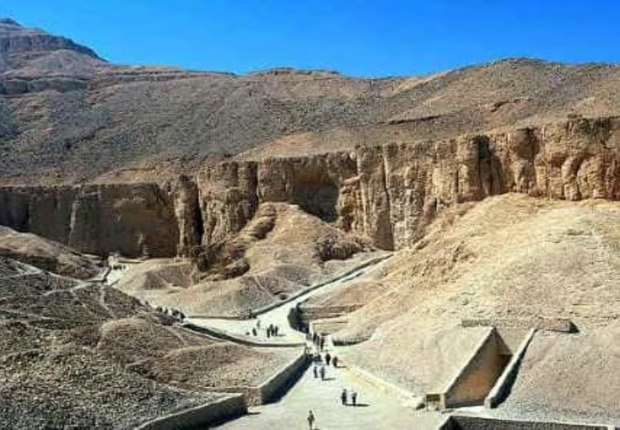
The Valley of the Kings holds 60-odd known tombs cut into the rock of a dry desert valley on the Luxor West Bank. You will not see all of them. A standard ticket admits you to three, and choosing which three is the single decision that shapes your visit.
How the ticket system works
Your general admission ticket covers entry to the valley plus any three open tombs. Which tombs are open rotates, partly to spread wear and partly for conservation work, so the list changes through the year.
Three tombs require a separate ticket bought on top of general admission:
- Tutankhamun (KV62). Small and architecturally plain, because he died young and was buried in a hurry. What is there is his mummy, on display in the tomb itself. Most of the treasure is in Cairo. Worth it for the significance rather than the scale.
- Seti I (KV17). The longest and most beautifully decorated tomb in the valley, running over 130 metres into the hillside. The separate ticket is expensive. Almost everyone who pays it says it was worth the money.
- Ramses V and VI (KV9). Superb astronomical ceilings, and usually far less crowded than Tutankhamun. Often the best value of the three extras.
Choosing your three included tombs
Ask your guide which are open on the day, then aim for variety rather than fame. Ramses III (KV11) has excellent painted side chambers. Ramses IX (KV6) is close to the entrance and well decorated. Merenptah (KV8) is large with a striking sarcophagus lid.
A practical tip: the tombs furthest from the entrance are usually the quietest, because most groups run out of time or energy before reaching them.
Photography rules
Photography inside the tombs requires a photo ticket, bought at the entrance. Rules are enforced and change periodically, so buy the ticket if you intend to take pictures rather than risk it. Flash is never permitted.
What else is on the West Bank
Most cruise itineraries pair the Valley of the Kings with two or three other stops on the same morning:
- Hatshepsut Temple at Deir el-Bahari. The terraced mortuary temple built into the cliff face, unmistakable in photographs.
- The Colossi of Memnon. Two 18-metre seated statues beside the road. A brief photo stop rather than a visit.
- The Valley of the Queens. Sometimes offered as an alternative. The tomb of Nefertari here is the finest painted tomb in Egypt, but entry is tightly restricted and costly.
Heat and timing
This matters more here than anywhere else on your trip. The valley is enclosed rock with no natural shade, and it traps heat. Inside the tombs, the air is still, humid from visitors’ breath, and often hotter than outside.
Cruise excursions start early for exactly this reason, frequently leaving the ship around 6am. Take the early start seriously. Carry more water than you think you need, and pace yourself between tombs rather than doing all three in one push.
Where it falls in your itinerary
Southbound sailings from Luxor typically visit the West Bank on day two, after Karnak Temple on day one, then sail toward Edfu Temple that afternoon. Northbound sailings from Aswan usually reach it near the end of the trip.
A sunrise hot air balloon flight over the West Bank, if you are adding one, happens before this excursion on the same morning.
Plan Your Trip
See our Luxor Travel Guide for the wider region, or check what a day onboard looks like before and after excursions like this one.
New to Egyptian history? See our history primer for Nile cruise travelers.