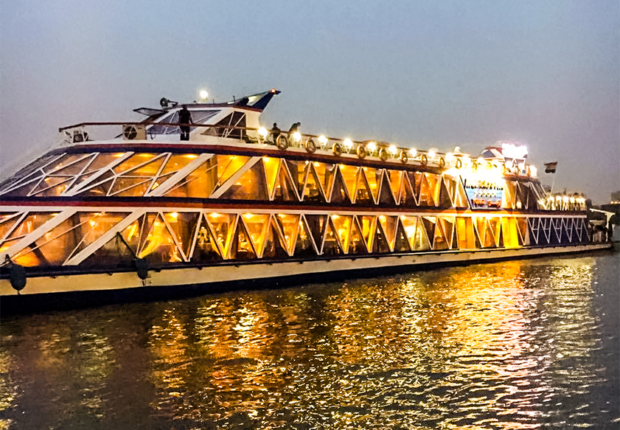
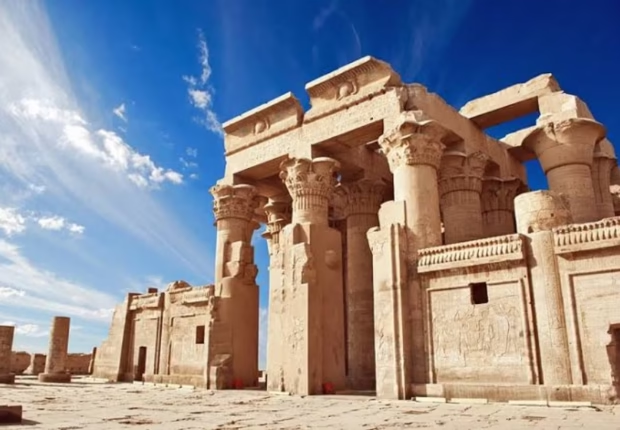
Kom Ombo Temple is the one stop on a Nile cruise where you step off the boat and the temple is right there, about fifty metres from the mooring. There is no coach transfer and no long walk. Most ships arrive in the late afternoon, and the sandstone glows orange in the low sun.
Why Kom Ombo Temple is unusual
Almost every Egyptian temple is dedicated to one god. Kom Ombo is dedicated to two, and it is split down the middle to prove it. The southern half belongs to Sobek, the crocodile god of fertility and the river. The northern half belongs to Haroeris, a form of the falcon god Horus.
This is not a subtle division. There are two entrances, two hypostyle halls, two sanctuaries, and two parallel axes running the length of the building. Stand in the centre and you can see the symmetry immediately. It is the clearest example of a double temple anywhere in Egypt.
What to look for while you are there
- The medical relief. On the rear outer wall, a carved panel shows surgical instruments: forceps, scalpels, bone saws, suction cups and a set of scales. It is one of the most photographed reliefs in Egypt and dates to the Roman period.
- The Nilometer. A deep circular well with a staircase spiralling down the inside. Priests used it to measure the annual flood, which determined the year’s taxes.
- The Crocodile Museum. A separate air-conditioned building beside the temple holding around twenty mummified crocodiles recovered from nearby, some over four metres long. Entry is usually included in your cruise ticket, but confirm this.
- The calendar wall. Carved lists of festival dates that helped Egyptologists reconstruct the ancient religious year.
How long you actually get
Guided visits typically run 60 to 90 minutes. The site is compact, entirely at ground level, and needs no climbing, so it is one of the easier stops for travellers with limited mobility or for families with young children.
Because ships often moor here in the late afternoon or early evening, Kom Ombo Temple is frequently lit after dark. If your ship arrives late, do not skip it. The floodlit columns are one of the better photographic opportunities of the trip.
Where it sits on your route
Kom Ombo lies between Edfu Temple and Aswan, roughly 45 kilometres north of Aswan. Southbound sailings from Luxor usually reach it on day three, after Edfu the same morning. Northbound sailings from Aswan often reach it on day two.
Both the four-night and five-night itineraries include it as standard. If a quote does not list Kom Ombo, ask why before booking.
Practical notes
There is very little shade on the temple platform. Bring water and a hat, particularly between May and September. The approach from the mooring passes a line of souvenir stalls where haggling is expected and firm but polite refusal works fine.
Photography is permitted throughout the temple grounds. Camera rules inside the Crocodile Museum vary, so check the sign at the entrance.
Is it worth prioritising?
If you are choosing which stops matter most, Kom Ombo ranks below Karnak Temple and the Valley of the Kings for sheer scale, but it is the most convenient stop on the whole route and the double-temple layout is genuinely unique. Given it costs you almost no travel time, there is little reason to miss it.
Plan Your Trip
See our Aswan Travel Guide for the wider region, or check Nile Cruise Prices and how many days you need to plan your route.